Sample Essays
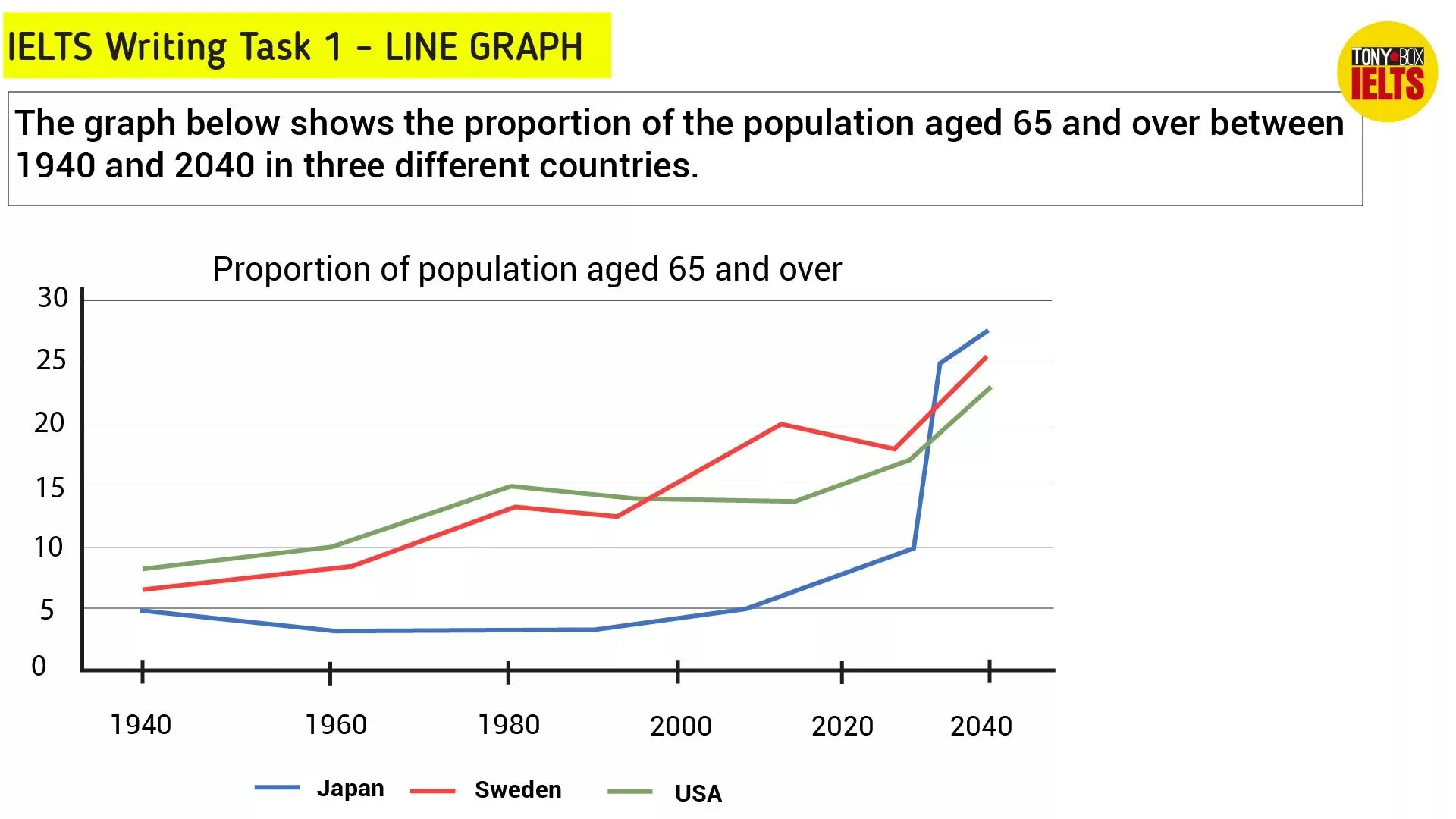
The line graph illustrates the percentage of people aged 65 and over in Japan, Sweden, and the USA between 1940 and 2040.
Перевод: Линейный график показывает процент людей в возрасте 65 лет и старше в Японии, Швеции и США в период с 1940 по 2040 год.
Почему хорошо:
- Используется парафраз: illustrates вместо shows, percentage of people aged 65 and over — грамотно переформулировано.
- Указан период и все объекты — структура ясна.
Overall, it is evident that all three countries experienced a growth in the proportion of elderly people over the entire period. While the figures for the USA and Sweden rose steadily, Japan saw a dramatic surge after 2030 and is projected to have the highest proportion by 2040.
Перевод: В целом, очевидно, что во всех трёх странах наблюдался рост доли пожилого населения за весь период. В то время как показатели для США и Швеции росли постепенно, Япония испытала резкий скачок после 2030 года и, согласно прогнозам, будет иметь наивысший показатель к 2040 году.
Почему хорошо:
- Отличное общее сравнение без цифр — это и есть цель Overview.
- Используются продвинутые фразы: it is evident, a dramatic surge, is projected to.
In 1940, the proportion of elderly individuals in the USA was approximately 9%, slightly higher than Sweden at 7% and Japan at 5%. Over the next 40 years, both Sweden and the USA experienced gradual increases, reaching around 14% and 15% respectively by 1980. Meanwhile, Japan remained relatively stable, fluctuating around 5%.
Перевод: В 1940 году доля пожилых людей в США составляла примерно 9%, что было немного выше, чем в Швеции (7%) и Японии (5%). В течение следующих 40 лет в Швеции и США наблюдался постепенный рост, достигнув примерно 14% и 15% соответственно к 1980 году. Между тем, показатель Японии оставался относительно стабильным, колеблясь около 5%.
Почему хорошо:
- Используется точная детализация с числами.
- Есть сравнение между странами.
- Используются слова уровня B2–C1: gradual increases, respectively, relatively stable, fluctuating.
From 1980 to 2000, the percentage of elderly in Sweden continued to rise, overtaking the USA. By 2000, both nations stood at around 14–15%, while Japan still had a relatively low figure of about 7%.
However, after 2020, Japan's elderly population rose sharply, and by 2040 it is projected to reach nearly 28%, overtaking both Sweden and the USA. Sweden is also expected to see a moderate rise to about 25%, while the USA will reach roughly 23% by the same year.
Перевод: С 1980 по 2000 год доля пожилых в Швеции продолжала расти, обогнав США. К 2000 году обе страны имели показатели около 14–15%, тогда как в Японии показатель оставался относительно низким — около 7%.
Однако после 2020 года число пожилых в Японии резко возросло, и, как ожидается, к 2040 году достигнет почти 28%, обогнав и Швецию, и США. Также ожидается, что в Швеции произойдёт умеренный рост до 25%, тогда как в США этот показатель составит примерно 23% к тому же году.
Почему хорошо:
- Есть чёткое развитие событий во времени.
- Употреблены сложные грамматические конструкции (is projected to, expected to see).
- Сравнение между странами + детализация будущего периода — это ценно в Task 1.
💡 Почему это 8.0–8.5?
| Критерий | Описание |
|---|---|
| Task Achievement | Полностью раскрыта тема, описаны все ключевые тенденции |
| Coherence & Cohesion | Логическая структура, хорошие связки (While, However, Meanwhile) |
| Lexical Resource | Широкий запас слов: surge, rise, slightly higher, projected, overtaking |
| Grammatical Range & Accuracy | Сложные времена, пассив, модальные конструкции, минимум ошибок |